Views: 5 Author: Site Editor Publish Time: 2026-10-20 Origin: Site
Table of Contents
When building or maintaining high-pressure hydraulic infrastructure, selecting the proper connection system determines whether your operation runs smoothly or suffers from catastrophic leaks and downtime. Two of the most prominent industrial options engineered by the Parker Ermeto original line are the Parker EO-2 and EO2-FORM systems.
While both systems share the same premium 24 degree cone hydraulic fittings body and elastomeric soft-sealing components, they utilize completely different mechanical methods to secure the hydraulic tubing. This direct comparative guide analyzes their core mechanics, performance parameters, and tooling costs to help you specify the right system for your facility to ensure leak free hydraulic connections.
For global manufacturing operations looking to mitigate supply-chain disruptions, alternative components matching these global specifications can be sourced from premium manufacturers like Fitsch, a leading Chinese hydraulic fittings supplier specializing in international standards.
The primary distinction between these two systems centers on how they create the structural "hold" on the tube. One relies on sharp, mechanical penetration, while the other relies on geometric reshaping.
The industry standard for premium Parker EO-2 fittings is built around a single component known as the Functional Nut. If you consult a standard Parker functional nut catalog, you will find that inside this pre-assembled piece sits a hardened metallic retaining ring and a large-volume elastomeric "DOZ" sealing ring.
When the nut is tightened onto a straight-cut hydraulic tube, the mechanical cutting edge bites progressively into the outer wall of the tube. This creates a uniform, deep anchor point that holds the tube against extreme system pressures, while the integrated elastomeric ring handles 100% of the fluid sealing. If you require standard-compliant replacements or high-volume stock, Fitsch's hydraulic tube fittings are manufactured using precision multi-CNC setups to match identical industrial dimensions. [1]
The Parker EO2-FORM system replaces the sharp bite mechanism entirely with a positive, form-fit connection. Instead of cutting into raw metal, the straight end of the tube is inserted into a specialized hydraulic tube cold forming machine. The machine compresses the metal between high-strength dies, permanently reshaping the tube end into a structural 24° solid cone matching the shape of the fitting.
Once formed, a standard EO-2 "DOZ" elastomeric seal is slipped over the new geometric contour. This approach matches the extreme rigidity and blow-out resistance of a traditional welded joint without any of the associated hazards or cleanup.
Technical Feature | Parker EO-2 System | Parker EO2-FORM System |
Mechanical Retention | Bite-Fit: Hardened metallic edge cuts into raw tube surface. | Form-Fit: Structural cold-forming transforms tube profile into a 24° cone. |
Assembly Method | Manual wrenches or basic pre-assembly tools. | Automated cold-forming workstation (F3 / PRO22). |
Blow-Out Risk | Low: Dependent on proper installer technique and torque. | Zero: Physically impossible due to the geometric shoulder block. |
Tightening Torque | Standard high torque required to shear and bite the tube. | Up to 25% lower torque required during final installation. |
Tube Wall Compatibility | Ideal for heavy, standard metric thick-walled tubing. | Highly versatile; supports thin-walled tubing down to 1 mm. |

Figure 1: Engineering configuration layout comparing various 24° cone connector methods. The diagram contrasts the (2) EO2-FORM soft sealed tube forming system against the (3) standard EO-2 soft sealed bite-type system and traditional (4, 5, 6) progressive cutting ring profiles for Series L and S hydraulic lines.
High-pressure operations require fittings that can survive dynamic systemic stress without backing out. Evaluating bite type fittings vs form fit setups highlights major differences in safety margins under severe fatigue.
Both systems offer outstanding pressure ratings that strictly comply with DIN 2353 fittings and ISO 8434-1 tube fittings dimensional requirements, frequently scaling up to 800 bar for the Heavy (S) series and 500 bar for the Light (L) series.
Because these dimensions follow global metrics rather than proprietary brand paths, procurement teams often leverage factory-direct components. For instance, Fitsch's stainless steel DIN 2353 fittings are rigorously checked by internal QA experts to ensure global interoperability across both Light and Heavy series lines.
However, EO2-FORM provides an added layer of safety. Because the tube itself has been structurally flared into a wider block contour, it acts as a physical mechanical stop. Even under unexpected extreme pressure spikes or external tension, the tube cannot be physically pulled or blown out of the fitting nut.
In traditional bite-type connections, continuous machine vibration can slowly back the nut off or widen the bite mark, creating "ghost leaks." Parker’s integrated, large-volume "DOZ" elastomeric seal solves this problem. Because the sealing function is entirely separate from the mechanical holding mechanism, systemic vibration does not cause the seal to back out or require continuous retightening over years of service.
The logistical differences between these two product lines determine how cost-effective they will be for your specific project timeline.
The primary benefit of standard EO-2 is its simplicity in the field. If a pipe ruptures on an offshore rig or a piece of heavy mobile machinery breaks down on-site, a technician only needs standard hand wrenches or a portable, power-free pump unit to complete a reliable installation. There is no need for specialized heavy machinery or electricity.
Conversely, EO2-FORM cannot be hand-assembled in the field without prior tube processing. It requires an upfront capital investment in a dedicated workshop machine like the EO2-FORM WorkCenter F3 or the high-volume PRO22.
While this adds initial cost, the machine automates the entire preparation cycle to roughly 1.4 seconds. This removes installer error, slashes workshop fabrication time for bulk assemblies, and completely eliminates the expensive labor, testing, and chemical pickling cycles required by traditional code-welded lines. For massive manufacturing arrays requiring scale, utilizing ready-made hydraulic assemblies and seamless tubes can further streamline shop throughput.
Choose the standard Parker EO-2 Functional Nut system if your operation prioritizes maximum field flexibility, decentralized machinery maintenance, or low volume, custom piping run setups where an upfront machinery investment isn't justifiable.
Specify the Parker EO2-FORM system if you are an OEM or managing high-volume facility fabrication workshops. It is the definitive choice for severe environment applications—such as cranes, marine construction, lifts, and high-vibration automotive stamping presses—where absolute zero-leak safety and maximum blow-out protection are non-negotiable.
If your facility requires a dependable supply of underlying standardized connectors to fuel your machinery lines, partnering with an agile manufacturer like Fitsch secures your component workflow against strict international project deadlines.

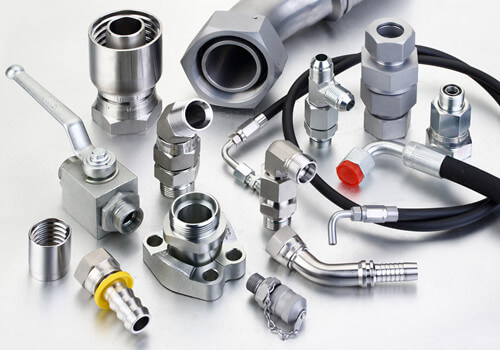
A comprehensive product showcase of premium 24° cone hydraulic components matching international DIN 2353 and ISO 8434-1 standards. Visible are stainless steel tees, crosses, swivels, adjustable elbows, and the loose green elastomeric EO-2 "DOZ" primary sealing rings that guarantee leak-free system operations.