Views: 1 Author: Site Editor Publish Time: 2026-11-05 Origin: Site
Introduction
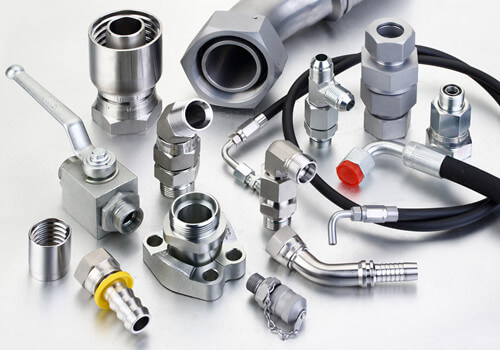
Stainless steel hydraulic fittings are the backbone of any fluid-power system that must resist corrosion, handle high pressure, and keep working in demanding environments. Whether you are specifying stainless steel hydraulic fittings for a marine vessel, an offshore platform, or a food-processing line, the right choice comes down to three questions: which material, which fitting type, and which thread standard. This guide answers all three, with comparison tables and a step-by-step selection process you can apply immediately.
Table of Contents
Hydraulic fittings connect hoses, tubes, pumps, valves, and actuators into a sealed system that transfers fluid under pressure. When the environment includes moisture, chemicals, salt, or washdown, stainless steel hydraulic fittings outperform carbon steel and brass because they resist corrosion far longer and hold up to extreme temperatures.
The main reasons engineers choose stainless steel:
Corrosion resistance — critical in marine, chemical, and offshore service.
Higher temperature tolerance compared to brass or zinc-plated steel.
Longer service life in humid or aggressive environments, reducing downtime and replacement cost.
Carbon steel fittings are cheaper but rust quickly when exposed to moisture or chlorides. Brass resists corrosion but is softer and unsuitable for high-pressure or high-temperature hydraulic lines. Stainless steel hydraulic fittings combine strength with corrosion resistance, making them the preferred choice for premium, long-life systems.
This is the most common question buyers ask. The short answer: 304 is often enough for general industrial use; choose 316 for chloride, saltwater, and harsh chemical environments.
Property | 304 Stainless | 316 / 316L Stainless |
Molybdenum content | None | 2–3% |
Chloride / pitting resistance | Good | Excellent |
Typical use | General industrial, mild chemical, indoor | Marine, offshore, chemical, food washdown |
Relative cost | Lower | Higher |
Salt spray (ASTM B117) | Limited, 24–96 hrs to first pitting | Much longer, preferred for marine |
For standard indoor hydraulic machinery, air lines, and environments with limited chloride exposure, 304 delivers excellent value and reliable corrosion resistance.
For marine equipment, offshore platforms, saline exposure, and frequent chemical washdown, 316 stainless steel hydraulic fittings are the safer choice because molybdenum resists pitting and crevice corrosion. If you operate near the sea, choose 316.
Fittings come in many shapes, each serving a specific job. The four main families are:
Stainless steel hydraulic hose fittings — crimped or reusable ends for flexible hydraulic hoses.
Stainless steel compression / double ferrule tube fittings — for rigid tubing, sealing via a ferrule compressed onto the tube.
Stainless steel hydraulic adapters & reducers — transition between thread types, tube sizes, or orientations (straight, elbow, tee, cross, bulkhead).
Quick couplings & bulkhead fittings — fast connect/disconnect and panel pass-through.
These attach hoses to ports and other components. They are available for every major thread standard and are often used with a crimping machine or as reusable field-attachable ends.
Also called stainless steel tube fittings, these use one or two ferrules that bite into the tube to form a high-pressure, leak-free seal. They are widely used in instrumentation, hydraulics, and gas lines where a reliable metal seal is required.
Adapters solve compatibility problems: converting JIC to NPT, metric to BSP, or straight to elbow. Every added connection is a potential leak point, so use only the transitions you genuinely need.
Thread standard determines whether two components can connect and how they seal. Mixing incompatible standards is a leading cause of leaks.
Standard | Thread angle | Sealing method | Dominant market |
NPT (tapered pipe) | 60° | On the threads (needs sealant) | North America |
BSPP / G (parallel) | 55° | Face washer or O-ring | Europe / Asia |
JIC (SAE J514) | 37° flare | Metal-to-metal flare | North America |
ORFS (SAE J1453) | 60° UNF | O-ring on flat face | North America, high-vibration |
DIN (metric, e.g. 2353) | metric | Compression ferrule | Europe |
NPT, BSP, JIC, ORFS, and DIN are not interchangeable without an adapter. Always confirm the male and female threads on both sides of a connection — thread form, angle, and sealing method must match.
Thread-sealing (NPT) relies on the threads themselves and needs tape or dope.
Face-sealing (ORFS, BSPP with washer) seals on a flat face or O-ring — better for high pressure and vibration.
Metal-to-metal flare (JIC) seals on the 37° cone; overtightening can damage the seat.
Saltwater and spray make stainless steel hydraulic fittings the standard for vessels, rigs, and dockside equipment. 316 stainless steel hydraulic fittings are preferred here for maximum pitting resistance.
Resistance to aggressive chemicals and frequent washdown makes stainless steel fittings essential for hygienic and corrosive media.
Excavators, presses, and production lines rely on stainless steel fittings where reliability and long service life justify the cost.
Identify the media (oil, water, chemical, gas) and its temperature.
Determine operating pressure — select a fitting rated at or above system pressure.
Choose the material — 304 for general use, 316 for chloride/marine/harsh service.
Confirm the thread standard on both connection ends (NPT, BSP, JIC, ORFS, DIN, metric).
Select the fitting type — hose, compression/tube, adapter, or quick coupling.
Verify size and thread dimensions (outer diameter, pitch, taper).
Check certifications (material certificate, ISO 9001, CE) and quality testing.
When sourcing stainless steel hydraulic fittings, verify:
Material certificate confirming the grade (304 / 316 / 316L).
ISO 9001 quality management.
Salt spray test (ASTM B117) results for marine service.
Tight thread tolerances against ANSI/ASME, ISO, or DIN standards.
What is the difference between 304 and 316 stainless steel fittings?
304 is suitable for general industrial use and mild chemical exposure. 316 contains 2–3% molybdenum for better resistance to chloride pitting and crevice corrosion.
When should I choose 316 stainless steel hydraulic fittings?
Choose 316 for marine service, offshore equipment, saline exposure, and frequent chemical washdown.
Can JIC and NPT fittings be used together?
Not directly. JIC and NPT use different thread forms and sealing methods; you need an adapter to convert between them.
What is the difference between BSP and NPT threads?
BSP (parallel) has a 55° thread angle and seals with a face washer or O-ring; NPT (tapered) has a 60° angle and seals on the threads with sealant.
How do I prevent leaks in stainless steel fittings?
Match the thread standard on both ends, use the correct sealing method, avoid overtightening flares, and use quality-certified fittings.
Fitsch.cn supplies stainless steel hydraulic fittings in 304, 316, and 316L, covering NPT, BSP, JIC, ORFS, and DIN standards for hydraulic hose, tube, and adapter applications. Need the right part for your system? Send us your specification — material, thread, size, and pressure — and get a free quotation and free samples, with material certificates included.