Views: 11 Author: Site Editor Publish Time: 2026-10-12 Origin: Site
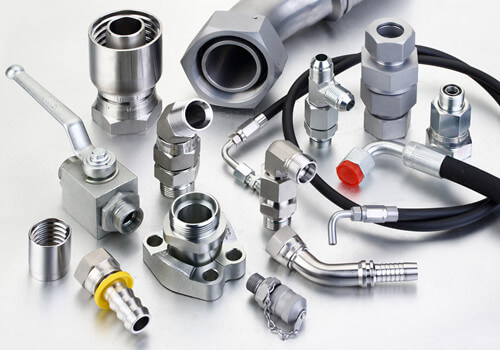
Carbon steel (Zinc-Nickel coated) and stainless steel (304 or 316L grade) are the primary materials used for central lubrication system tube fittings and hose sleeves conforming to DIN 2353 and ISO 8434-1. These materials ensure the high tensile strength and thread integrity required to handle system operating pressures from 100 bar up to 630+ bar.
Table of Contents
Fitting Body & Nut (DIN 2353 / ISO 8434-1): Manufactured from high-tensile carbon steel or stainless steel. When carbon steel is used, it is treated with a Zinc-Nickel (Zn-Ni) alloy coating to provide maximum defense against rust and atmospheric corrosion. The nut must match or exceed the strength of the body to withstand heavy assembly torque without stripping.
Cutting Ring / Ferrule: Formed from case-hardened carbon steel or specially treated stainless steel. The cutting ring must be harder than the lubrication tubing it joins; this allows the sharp internal edge to bite securely into the tube wall to create a leak-free mechanical seal.
Hose Stud & Screw Sleeve (Threaded Hose Sleeves): Constructed from heavy-duty galvanized steel or stainless steel. The screw sleeve features a reverse internal thread to grip the outer rubber jacket of a high-pressure line, while the hose stud features a hardened, barbed profile that compresses against the tube's core.
Component Name | Standard Material Options | Coating / Finish | Purpose & Selection Note |
Fitting Body | Carbon Steel 20(L shape Elbow) 35(LL series Straight) 45(Non return valves) / Stainless Steel 304 316L | Zinc-Nickel or Galvanized (Cr. VI-free) | Main structural connection; holds internal cutting ring seating geometries. |
Nut | Carbon Steel 35(LL) 45(L S series) / Stainless Steel 304 316L | Zinc-Nickel or Galvanized (Cr. VI-free) | Drives the cutting ring forward into the tube body during torque application. |
Cutting Ring | 10 20 Steel / Stainless Steel 316L | Zinc-Nickel or Phosphated | Must be hard enough to slice and indent into steel or hard nylon tubing. |
Hose Stud | Carbon Steel 20(elbow or straight) 35(Straight)/ Stainless Steel 304 316L | Zinc-Nickel or Zinc-Plated (Cr. VI-free) | Inserted inside high-pressure rubber hose cores; acts as the fluid conduit. |
Screw Sleeve | Carbon Steel MA08AI or C35/ Stainless Steel 304 316L | Zinc-Nickel or Galvanized (Cr. VI-free) | Counter-threaded outer collar that locks high-pressure flexible hoses to the stud. |
Material Category | USA Grade & Standard (ASTM/SAE) | Germany Grade & Number (DIN/EN) | Chinese Grade & Standard (GB/T) | Typical Component Application |
Free-Cutting Steel | SAE / AISI 1215 | 11SMn30 / W-Nr. 1.0715 | Y1215 / Y1215m / GB/T 8731 | Threaded hose sleeves, hex connectors, plugs |
Al-Killed Carbon | AISI 1008 (Al-killed) | C8E / W-Nr. 1.0313 | ML08Al / MA08Al / GB/T 6478 | Cold-extruded fluid nuts, screw sleeves, rivets |
Low Carbon Steel (10) | AISI 1010 | C10E / W-Nr. 1.1121 | 10 Steel / GB/T 699 | Low-pressure sleeves / stamped caps |
Low Carbon Steel (20) | AISI 1020 | C20E / W-Nr. 1.1151 | 20 Steel / GB/T 699 | Standard hose studs, light fluid ports |
Medium Carbon Steel (35) | AISI 1035 | C35E / W-Nr. 1.1181 | 35 Steel / GB/T 699 | High-tensile DIN 2353 fitting bodies & nuts |
Medium Carbon Steel (45) | AISI 1045 | C45E / W-Nr. 1.1191 | 45 Steel / GB/T 699 | Case-hardened cutting rings, high-torque nuts |
Austenitic Stainless (304) | AISI 304 | X5CrNi18-10 / W-Nr. 1.4301 | 06Cr19Ni10 / GB/T 20878 | Corrosion-resistant fitting bodies & nuts |
Low-Carbon Stainless | AISI 316L | X2CrNiMo17-12-2 / W-Nr. 1.4404 | 02Cr17Ni12Mo2 / GB/T 20878 | Severe chemical / marine distribution blocks |
Stabilized Stainless | AISI 316Ti | X6CrNiMoTi17-12-2 / W-Nr. 1.4571 | 06Cr17Ni12Mo2Ti / GB/T 20878 | Premium high-temp/high-pressure fluid lines |
The deliberate addition of Sulfur (0.26–0.35%) and Phosphorus (0.04–0.09%) to Y1215 forms fine manganese sulfide stringers. These act as natural chip-breakers during automatic lathe turning, lowering tool wear and maximizing production speeds.
Material Grade | Carbon (C) | Silicon (Si) | Manganese (Mn) | Chromium (Cr) | Nickel (Ni) | Molybdenum (Mo) | Sulfur (S) / Phosphorus (P) | Other |
Y1215 / 1.0715 | ≤ 0.14 | ≤ 0.05 | 0.90 – 1.30 | — | — | — | S: 0.27 – 0.33 | — |
ML08Al / MA08Al | 0.05 – 0.10 | ≤ 0.10 | 0.30 – 0.60 | ≤ 0.10 | ≤ 0.20 | — | S: ≤ 0.035 / P: ≤ 0.035 | Al: ≥ 0.02 |
10 / AISI 1010 | 0.07 – 0.13 | 0.17 – 0.37 | 0.30 – 0.60 | ≤ 0.15 | ≤ 0.25 | — | S: ≤ 0.035 / P: ≤ 0.035 | — |
20 / AISI 1020 | 0.17 – 0.23 | 0.17 – 0.37 | 0.35 – 0.65 | ≤ 0.25 | ≤ 0.25 | — | S: ≤ 0.035 / P: ≤ 0.035 | — |
35 / AISI 1035 | 0.32 – 0.40 | 0.17 – 0.37 | 0.50 – 0.80 | ≤ 0.25 | ≤ 0.25 | — | S: ≤ 0.035 / P: ≤ 0.035 | — |
45 / AISI 1045 | 0.42 – 0.50 | 0.17 – 0.37 | 0.50 – 0.80 | ≤ 0.25 | ≤ 0.25 | — | S: ≤ 0.035 / P: ≤ 0.035 | — |
304 / 1.4301 | ≤ 0.07 | ≤ 1.00 | ≤ 2.00 | 17.50–19.50 | 8.00–10.50 | — | S: ≤ 0.030 / P: ≤ 0.045 | — |
316L / 1.4404 | ≤ 0.03 | ≤ 1.00 | ≤ 2.00 | 16.50–18.50 | 10.00–13.00 | 2.00 – 2.50 | S: ≤ 0.030 / P: ≤ 0.045 | — |
316Ti / 1.4571 | ≤ 0.08 | ≤ 1.00 | ≤ 2.00 | 16.50–18.50 | 10.50–13.50 | 2.00 – 2.50 | S: ≤ 0.030 / P: ≤ 0.045 | Ti: 5 × C to 0.70% |
Values reflect cold-drawn (C) conditions for carbon/free-cutting steels and annealed states for stainless steels, matching standard bar stock delivery formats for hydraulic component manufacturing.
Material Grade | Yield Strength ((Rp0.2, MPa) | Tensile Strength (Rm, MPa) | Elongation (A₅, %) | Delivery Hardness (HBW) |
Y1215 / 1.0715 | ≥ 415 | ≥ 540 | ≥ 10 | 160 – 200 HBW |
ML08Al / MA08Al | ≥ 195 | ≥ 315 | ≥ 32 | ≤ 131 HBW |
10 / AISI 1010 | ≥ 205 | ≥ 335 | ≥ 24 | ≤ 140 HBW |
20 / AISI 1020 | ≥ 245 | ≥ 410 | ≥ 20 | ≤ 156 HBW |
35 / AISI 1035 | ≥ 315 | ≥ 530 | ≥ 20 | ≤ 197 HBW |
45 / AISI 1045 | ≥ 355 | ≥ 600 | ≥ 16 | ≤ 229 HBW (Can be surface hardened to >50 HRC) |
304 / 1.4301 | ≥ 210 | 520 – 720 | ≥ 45 | ≤ 215 HBW |
316L / 1.4404 | ≥ 220 | 520 – 670 | ≥ 45 | ≤ 215 HBW |
316Ti / 1.4571 | ≥ 240 | 540 – 690 | ≥ 40 | ≤ 215 HBW |
Tsing Tuo Mill Test Certificate 316L for central lubrication system tube fittings and non return valves
Zhejiang Yuanli Product Quality Certificate — 35#, 45# carbon steel for central lubrication system tube fittings and non return valves
Tsing Tuo Mill Test Certificate — S304 stainless steel for central lubrication system DIN 2353 cutting ring fittings
Jiangsu Shagang Quality Certificate — ML08Al high-speed wire rod for DIN 4LL 6LL tube nuts
Shagang Huaigang Mill Test Certificate — Grade 20 carbon steel for lubirication elbow male connector L shape material
Jinhang Steel Tube Mill Test Certificate — 10# Seamless Steel pipe for cutting rings
Connector bodies
Bodies shall be manufactured from carbon steel that will provide the minimum pressure/temperature requirements specified in Clause 5. They shall have characteristics that make them suitable for use with the fluid to be conveyed and that will provide an effective joint. Weld connector types and weld-on nipples shall be made of materials classified as suitable for welding.
For bodies manufactured from stainless steel and copper alloys, the pressure/temperature ratings need to be defined by the manufacturer.
Nuts
Nuts to be used with carbon steel bodies shall be made of carbon steel, and those for use with stainless steel bodies shall be made of stainless steel, unless otherwise specified. Nuts to be used with copper alloy bodies shall be made of a material similar to the bodies.
Cutting rings
The ring material shall be compatible with the fluid to be conveyed and provide an effective joint.
Steel cutting rings are to be used in combination with other steel connector components and steel tubes.
Stainless steel cutting rings are to be used in combination with other stainless steel connector components and stainless steel tubes.
Brass cutting rings are to be used in combination with other brass connector components and copper tubes.
Other combinations of materials shall be agreed upon between the purchaser and supplier.
Connectors in conformance with this document made of carbon steel shall meet or exceed
without leakage the requirements from a vacuum of 6,5 kPa (0,065 bar) absolute pressure to the working pressures given in Tables 1 to 3 when used at temperatures between -40 °C and +120 °C with petroleum-base hydraulic fluids.
Connectors conforming to this document can contain elastomeric seals. Unless otherwise
specified, connectors are made and delivered with elastomeric seals for use within the specified working temperature range with petroleum-base hydraulic fluids. The use of these connectors and elastomeric seals with other hydraulic fluids may result in a reduced working temperature range or may render the connectors unsuitable for the application. Manufacturers may supply, upon request, connectors with elastomeric seals for use with hydraulic fluids other than petroleum-base hydraulic fluids which will meet the specified working temperature range of the connectors.
The connector assembly shall meet or exceed all applicable performance requirements given in Clause 15. Testing shall be conducted at room temperature.
For applications under conditions other than the pressure and/or temperature limits given in
Tables 1 to 3 and in 5.1 and 5.3, the manufacturer shall be consulted.
According to different applications and different pressure ratings, there are three series of
connector, designated by
- LL, for extra light-duty,
- L, for light-duty, and
- S,for heavy-duty.
Ranges of the tube outside diameters and pressure requirements are shown in Tables I to 3.
Table 1 - Working pressures for 24° cone connectors for fluid power and general use
Table 2 - Working pressures for 24° cone connectors, for general use only
Table 3 - Working pressures for 24° cone weld-on nipples with various tube wall thicknesses
15.1 General
The connectors shall meet or exceed the pressure requirements given in Table 1 when tested in
accordance with this clause.
15.2 Repeated assembly test
The connectors shall pass a repeated assembly test in accordance with ISO 19879.
15.3 Proof test
The connectors shall pass a proof test in accordance with ISO 19879.
15.4 Burst pressure test
The connectors shall pass a burst pressure test in accordance with IS0 19879
15.5 Cyclic endurance (impulse) test
The connectors shall pass a cyclic endurance test in accordance with ISo 19879. The cyclic endurance test with vibration specified in ISO 19879 may be used in place of separate cyclic endurance and
vibration tests.
15.6 Vibration test
The connectors shall pass a vibration test in accordance with ISO 19879. The cyclic endurance test with vibration specified in ISO 19879 may be used in place of separate cyclic endurance and vibration tests.
15.7 Leakage (gas) test
The connectors shall pass a leakage (gas) test in accordance with ISO 19879.
15.8 Overtightening test
15.8.1 Connectors with cutting rings
15.8.1.1 For each size, three samples each of the cutting ring connection ends shall be tested.
15.8.1.2 Tighten the cutting ring connection end to finger-tight position plus the number of turns recommended by the manufacturer, and record the resulting torque. Apply an overload of 30 % of the recorded torque, not to exceed 100 Nm. The connection shall be capable of withstanding this overload
with no indication of the following failures:
- the nut cannot be removed and swivels freely after breakaway;
- visible cracks or severe deformation appear that would render the connector component unusable.
15.8.2 Connectors with O-ring seal cone (DKO)
15.8.2.1 For each size, three samples of the 0-ring seal cone (DKO) ends shall be tested.
15.8.2.2 Apply the manufacturer's recommended torque plus an overload of 30 % of the recommended torque, not to exceed 100 Nm. The connection shall be capable of withstanding this overload with no
indication of the following failures:
- the nut cannot be removed and swivels freely after breakaway;
- visible cracks or severe deformation appear that would render the connector component unusable.
15.9 Vacuum test
The connectors shall pass a vacuum test in accordance with ISO 19879.